Empath & The Narcissist bio
A compassionate spiritual healing guide specializing in support for empaths recovering from narcissistic abuse. With over a decade of experience in trauma-informed coaching, human design, and energy work, she combines practical boundary-setting tools with soulful practices that restore emotional safety and self-trust. Trained in compassionate listening and somatic techniques, she helps clients recognize patterns, reclaim their power, and rebuild grounded, authentic lives. Her approach is gentle, clear, and empowerment-focused—guiding empaths from overwhelm and hyper-empathy to resilience, healthy connection, and aligned purpose.
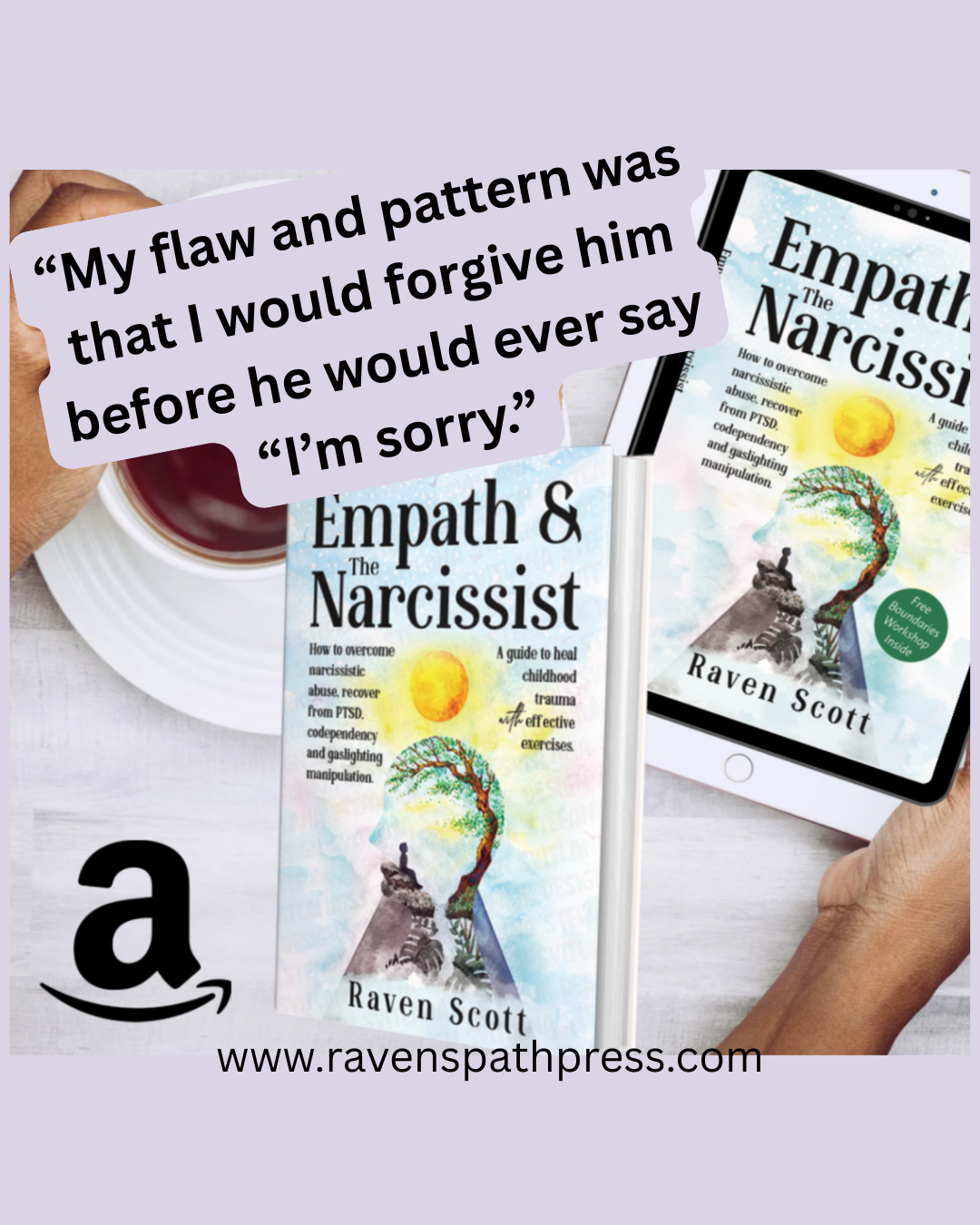
My flaw and pattern was that I would forgive him before he would ever say “I’m sorry."
I forgave to preserve peace, to numb the ache of disappointment, and to prove I was the steady one. Forgiveness became my first line of defense — an automatic offering that erased my bravery and, in doing so, erased my boundaries. He never had to change because my forgiveness allowed him to stay the same. Over time I learned that forgiving reflexively is not holiness; it’s a survival strategy that keeps the abuse cycle going. Healing began when I taught myself to wait for accountability, to honor my pain, and to let apologies mean something again. Now I forgive from a place of strength, not absence — choosing restoration only when it’s earned.
Discover the power to stop forgiving too quickly—and finally reclaim your boundaries.
Are you an empath who keeps giving second chances to someone who keeps hurting you? "Empath and the Narcissist" is written for people like you: deeply feeling, compassionate, and exhausted from a cycle of charm, manipulation, and repeated pain. This book isn't about forcing you to become cold or unforgiving. It's about giving you the tools to choose who deserves your trust and when forgiveness is healthy—so the abuser can no longer use your compassion as permission to continue hurting you.
Stop allowing compassion to be a loophole for abuse. "Empath and the Narcissist" gives you the knowledge, language, and practical tools to decide when forgiveness is truly healing—and when it’s just keeping you hurt. Reclaim your power. Choose safety and clarity over repeated pain.
Narcissists are individuals who have an inflated sense of self importance.Narcissists are individuals who hold an inflated sense of self-importance, often believing they are superior to others and deserving of special treatment. This exaggerated self-view drives a constant need for admiration and validation, while empathy for others is limited or selectively applied. Their behaviors can include arrogance, entitlement, exploiting relationships for personal gain, and reacting poorly to criticism. Recognizing these patterns helps survivors of narcissistic abuse set boundaries, prioritize healing, and reclaim their sense of self.
Your Human Design Inner Authority is how your intuition talks to you — the specific voice or felt-sense your body uses to guide decisions that are aligned with your true self. For empaths, who are highly sensitive to energy and emotions around them, understanding your Inner Authority helps you distinguish your authentic guidance from other people’s feelings or external pressures. Below are the Inner Authority types described in Human Design, with practical notes for empaths on how each one experiences intuition and how to honor it.
Sacral Authority
How the intuition speaks: A visceral, immediate “yes” or “no” response in the gut — a quick, energetic hit or sound that feels correct.
For empaths: The sacral voice can be muddied by absorbed emotions. Ground first: pause, breathe, sense into your own belly while creating energetic boundaries. Ask simple yes/no questions and notice the gut’s spontaneous response rather than trying to analyze it.
Emotional (Solar Plexus) Authority
How the intuition speaks: Through waves of emotion; clarity comes over time as feelings settle. Decisions are best made after riding an emotional wave to see what remains steady.
For empaths: This is easily confounded with others’ emotions. Create intentional delay and self-checks. Wait through at least one emotional cycle (sometimes a day, sometimes longer) and observe how your inner emotional landscape changes when you’re alone and grounded.
Splenic Authority
How the intuition speaks: Instant, quiet, bodily sensations or instincts — a soft “knowing” or immediate physical sense of safety/danger.
For empaths: Because you pick up ambient feelings, cultivate stillness and solitude to hear the splenic whisper. Trust the first instinctive hit but verify with calming practices (breathwork, nature, brief grounding) to filter out borrowed sensations.
Ego (Heart) Authority
How the intuition speaks: Through willpower, desire, and the body’s “I want” signals — a sense of motivation or determination when something is truly aligned with personal value.
For empaths: Differentiate between true desire and desire shaped by others’ expectations. Tune into your chest area and test whether the want increases as you quiet external input. Choose decisions that energize you rather than drain you.
Self-Projected Authority
How the intuition speaks: Through voice and identity — clarity emerges by speaking out loud and hearing what resonates. The self’s truth is found in self-expression and conversation.
For empaths: External emotional noise can influence what you hear back, so choose trusted, neutral listeners or speak alone first (recording yourself or journaling out loud). Use your vocal expression as a filter: what feels steady when articulated is likely yours.
Mental Projected Authority (Projectors without defined emotional centers)
How the intuition speaks: Through mental recognition and the feedback of trusted others; clarity comes from being seen and from invitations or responses.
For empaths: Because you’re sensitive to others’ feedback, prioritize feedback from people who know how to hold healthy boundaries. Use clear invitations and notice which responses align with your inner calm rather than reactive relief.
Lunar Authority (Reflectors)
How the intuition speaks: Through the lunar cycle — clarity arrives over a full moon cycle as outer conditions reveal what’s consistent.
For empaths: Reflectors absorb community energy deeply. Give yourself a full 28-day cycle when possible for big decisions. Track how choices feel across the cycle and note patterns that reflect your authentic experience rather than short-term emotional contagion.
No Inner Authority (Traditional systems vary)
How the intuition speaks: Some designs emphasize following strategy, external timing, or other centers rather than an individualized inner authority.
For empaths: When internal signals are unclear, rely on embodied routines: grounding practices, waiting periods, and consultation with grounded guides to filter out others’ energies before deciding.
Practical grounding and boundary tips for empaths using your Inner Authority
Create a short grounding ritual before making any decision: breathe, place feet on the floor, imagine a protective bubble, and check the bodily signal relevant to your authority.
Practice small decisions to build trust in your inner voice — ask yes/no questions for sacral authority, or wait a set period for emotional authority to see the pattern.
Solitude and sensory moderation help: reduce incoming stimuli when you need clarity (short time alone, limits on social media, quiet).
Keep a decision journal: note the authority you used, the felt sense, and the outcome. Over time this trains your awareness and helps distinguish your intuition from absorbed energy.
Learn phrasing that suits your authority: sacral queries framed as yes/no; emotional authority uses “I will decide after…”; splenic authority notes first instinct; self-projected uses speaking-out-loud; lunar tracks a time window.
Your Inner Authority is the individualized unique just for you. Learn more about your unique authority based on your Human Design birth chart with a 1 hour reading with Raven.